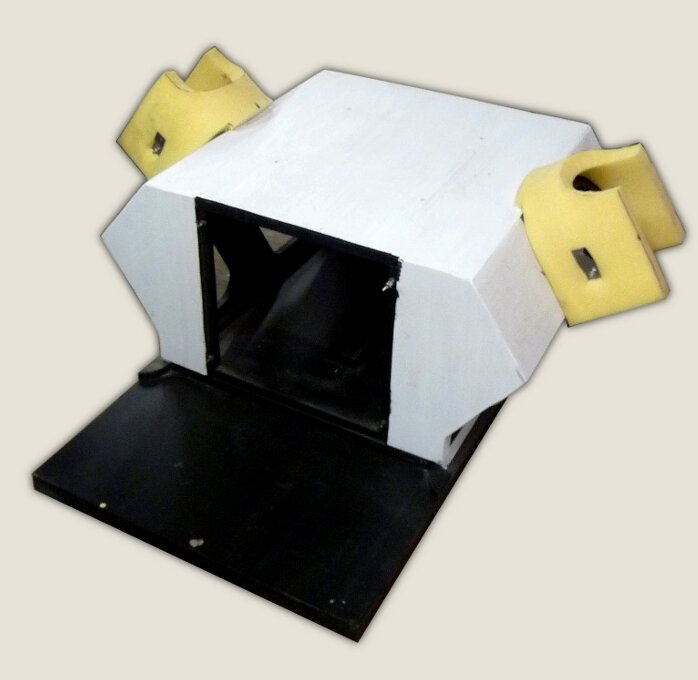
Aflatoxin Screener - Under Development
*Update*
The International Crops Research Institute for the Semi-Arid-Tropics, better known as ICRISAT, will be testing our UV aflatoxin detection technology in combination with the Universal Nut Sheller in Mali this fall.
From our testing in Guatemala:

The photo above was taken during field testing of the Aflatoxin Screener in Guatemala in cooperation with Vanderbilt University. Above you'll see the same photo twice. At the bottom is the untouched photo. Above you'll see the same photo with the brightness enhanced so peanuts are more easily visible. Areas where Aspergillus flavus has contaminated the shells fluoresce bright blue under the UV light.
The Story of the UV Scanner
Our founder Jock Brandis has an affinity for old farm equipment and techniques and the old farmers who remember those sorts of things. Jock was having a conversation with an old North Carolina peanut farmer, discussing the aflatoxin issue when the farmer recalled that aflatoxin had been a problem for local farmers in the 1950's. They learned that infected peanuts could be identified under black light. When viewed under ultra violet light aflatoxin contaminated peanuts appear brighter than uncontaminated peanuts.
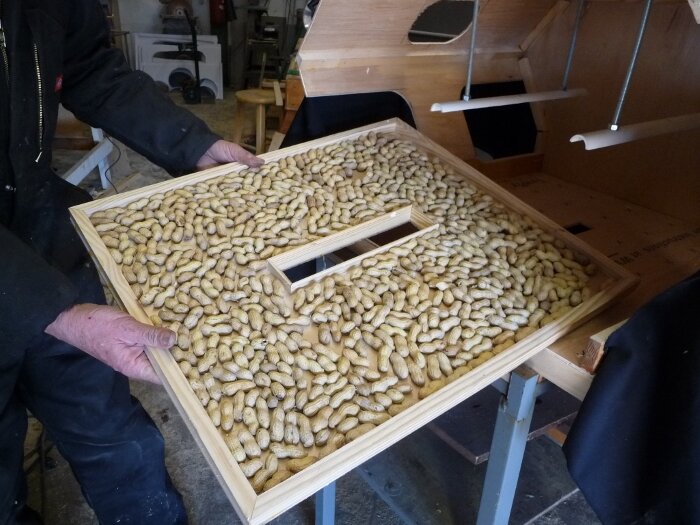
Armed with this information Jock fashioned a darkened box with viewing ports where shallow trays of peanuts could be viewed under arrays of ultra violet light. Two screeners working on each side of the box manually pick out the contaminated peanuts and discard them in a slot cut into the middle of the tray.
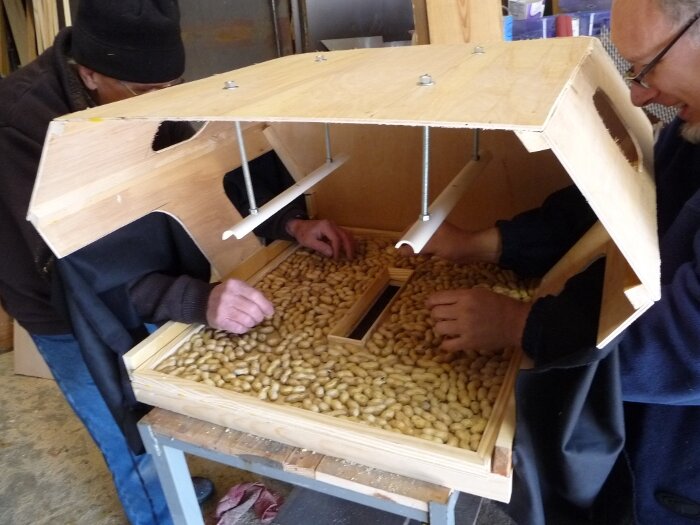
Seen here in cut away two screeners sort the peanuts illuminate by arrays of ultra violet lights seen attached to the top of the box with long screws. We are experimenting with solar powered applications.
Recent testing has suggested that 4 operators can screen 2000 lbs of peanuts in a day. Field testing in Haiti reduced aflatoxin contamination down to 11 parts per billion, better than the acceptable USDA standard.